


PRN file for Dcode printers
Send us your label and we send back a ready-to-print .prn file in TSPL-compatible — the language your Dcode printer reads directly. Copy it to the printer and the label comes out. No designer, no licence, nothing to install on the machine that prints it.
This is a paid service. The price depends on the label, and we quote before we start — the quote does not move afterwards.
What a PRN file actually is
A label printer does not understand a Word document or a PDF. It understands a stream of instructions — TSPL-compatible on a Dcode — that says where to put a line, how tall the barcode is, which font, how dark to burn. A .prn file is that stream, saved to disk.
Design software normally writes that stream and throws it away every time you press print. We write it once, get it right, and hand you the file. From then on printing the label is copying a file — which any computer, any ERP and any handheld can do, and which never expires.
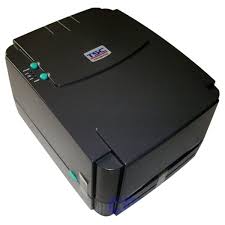
Dcode printers take a TSPL-style command set. They are widely used in retail and courier work in India, where the label is the same shape ten thousand times a day and nobody should be opening a designer to print it.
Why people ask us for one
- The ERP can only send a file. Tally, SAP, a custom billing system, a warehouse app — plenty of them can push a file at a printer and nothing more. A PRN file is the whole label in that one file.
- No licence on the printing PC. The shop-floor machine does not need label software, so there is no licence to buy for it and no licence to renew next year.
- The same label, thousands of times. A fixed carton label, an MRP sticker, a rating plate. It should not need an operator opening a designer and getting the margins wrong.
- A customer has dictated the label. Marketplace shipping labels, automotive and pharmaceutical layouts, GS1 barcodes with a fixed bar height and quiet zone. There is no room to improvise, and a file that has been measured is safer than a design somebody redraws each time.
- The printer is in another city. Email the file, they print it. Nothing has to be installed at the far end and nobody has to be talked through a designer over the phone.
How you print it
Three ways, and we set one of them up with you on a remote session so it works before we hang up.
Windows
copy /b label.prn \\PC\Labels
Share the printer under a short name and the copy command sends the file to it raw, without the driver touching it.
Linux or a server
lp -d Labels -o raw label.prn
Raw mode matters — without it CUPS tries to be helpful and renders the file as text.
Straight over the network
port 9100
An Ethernet or Wi-Fi printer will take the file on port 9100 from any script, any language, any operating system.
What we need from you
- The exact printer model — which Dcode, not just the brand
- Label size in millimetres, the gap between labels, and how many across the roll
- Direct thermal or thermal transfer, and the ribbon if there is one
- The artwork, or a photograph of the label you print today
- Which fields change from label to label, and where that data comes from
- The barcode type — Code 128, EAN, GS1-128, DataMatrix, QR — if you know it. If you do not, send a sample and we will read it.
Where we have the same printer on the counter, the file is tested on it before it reaches you. Where we do not, we test it on the closest model we have and then prove it on yours over AnyDesk.
The file is only half of it — the stock has to match
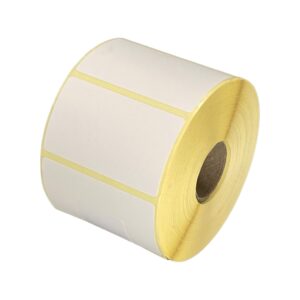
A file measured for a 100 × 150 mm label will not print on 100 × 100 mm stock, and a thermal transfer file on direct thermal paper comes out blank. We cut labels to size and supply ribbons to match, which is the other half of what this office does all day — so the simplest thing is usually to have the file and the roll come from the same place.
Direct thermal labels Thermal transfer labels Ribbons Polyester and synthetic labels Dcode printers
Questions we get asked
- What is a PRN file for a Dcode printer?
- It is your label already converted into TSPL-compatible, the language a Dcode printer reads directly. Sending the file to the printer prints the label. There is no design software in the path, nothing to install and no licence to renew.
- Do I need any software to print it?
- No. On Windows you can send it from a command prompt with a copy command; on Linux with lp in raw mode; over a network straight to port 9100. Most ERP, billing and warehouse systems can send a file to a printer on their own, which is usually why the file is wanted in the first place.
- Can the label carry different data each time?
- Yes. We can leave placeholders in the file for your system to substitute before it sends, or build the counter into the file so the printer numbers the labels itself. Tell us which fields change and how they reach you.
- What does it cost?
- It is a paid service and the price depends on the label — how many fields it carries, whether the artwork has to be redrawn and whether the data is variable. We quote before we start, and the quote does not move afterwards.
- Will it print correctly on my labels?
- Only if the stock is right, which is why we ask for the exact label size, the gap and whether you are on direct thermal or thermal transfer. We supply labels and ribbons cut to size, so the simplest answer is usually to have the file and the stock come from the same place.
Paying for it
We invoice with GST and the work starts once payment is confirmed. Bank transfer is the usual route, from India or overseas.