



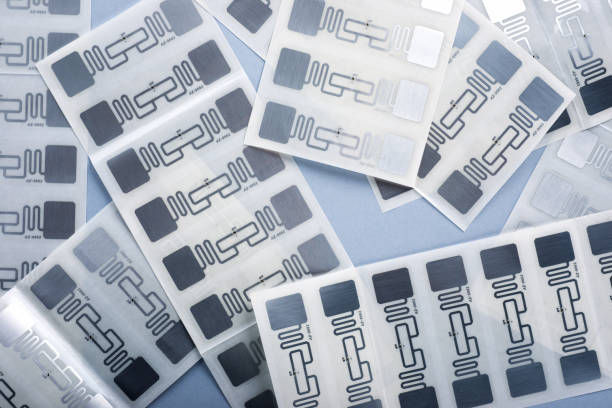
Types of RFID tags: Which one is best for your business?
RFID tags can be divided into three main categories, each with different characteristics depending on the needs of your business:
- Passive tags: They have no power source of their own, so they are activated by the external wave energy created by the antenna and the RFID reader. This characteristic makes them short-range tags and their reading range (0-15 meters distance) is limited by the power needed to activate the chip. It is the most common tag, given its dimensions and price.
- Active tags: They have their own power supply, so they activate their integrated circuits and constantly transmit a signal. They have a greater reading range (up to 100 meters) than passive tags. They are the most expensive tags (due to the cost of their battery and transmitter).
- Semi-active tags: They are a mixture of the 2 previous ones: they are activated by the signal received from the RFID reader, but also have a battery that powers the chip. It allows you to store information and respond quickly and securely. They have a higher reading range than passive tags, but their cost is higher and their useful life is shorter due to the battery.
Storage capacity of the tags: What can we store?
RFID and NFC tags can store more than just a unique identifier, allowing the inclusion of useful information for applications such as product traceability. There are three types of memory in RFID tags:
EPC memory: Stores a unique code to identify products. Its standard size is 96 bits or 128 bits, but can vary depending on the application. Some chips allow more bits to be reallocated from user memory.
Frequency: Choosing the right frequency for your business
Depending on the industry your company operates in and the environmental conditions, RFID tags work best in different frequency ranges:
- Low Frequency (LF): Ideal for applications where metal or liquids are present, such as the industrial sector or asset tracking in harsh conditions.
- High Frequency (HF/NFC): Used to identify objects at close range in pharmaceutical applications. Another common application is tickets for access control and libraries.
- Ultra High Frequency (UHF): These are most commonly used for long-range applications and large volumes of inventory, such as in logistics and retail. Although they have greater range, they are more sensitive to interference.
Environmental conditions: Where will the RFID tag operate?
One of the most common mistakes when implementing RFID is not considering environmental conditions. If your business operates in industrial environments where metal, moisture, extreme cold or heat are present, you need specialized RFID tags:
- Metal-resistant tags: Optimized to operate near metal surfaces without losing effectiveness.
- Extreme temperature resistant tags: Suitable for processes involving heat, such as manufacturing, or cold environments, such as cold storage. At Mindware, we manufacture labels that can withstand over 240 degrees.
- Waterproof labels: These are essential for products exposed to moisture or water, such as in the food industry or outdoor applications.
Durability and life cycle: How long do you need the label to last?
Another key factor is durability. Depending on whether the labels will be used on disposable applications (such as retail products) or on reusable assets (such as pallets, pallets or containers), you need to choose a label that can withstand the necessary life cycle.
- Single-use labels: Ideal for products that only require one-off traceability, such as sales items.
- Durable labels: Ideal for long-term applications, where the label must survive harsh conditions and continue to function accurately.
Size and shape: Make sure the label fits your products.
The size and shape of the RFID tag also influences its performance. Tags can be tiny for small products or robust for large assets. A good practice is to work with a supplier like Mindware RFID, who can customize the shape and size of the tag to your needs.
Regulations and compatibility with your current system
We manufactures RFID tags in different frequencies to cover the multiple applications found in Industry 4.0: UHF (860-960 MHz EPC Class1 Gen2), HF (13.56 MHZ ISO 18000-3), LF (125-134 KHz ISO 18000-2) and NFC (13.56MHZ ISO 14443 A NFC Forum). Our RFID tags comply with international standards. If your business operates globally, it is essential to choose tags that conform to international standards, such as ISO or global EPC (860-960 MHz).
Compatibility with your current infrastructure is crucial to ensure a smooth implementation. RFID tags must be compatible with the readers, management systems or ERP software you already have in place. At Mindware, we offer RFID tags that are adaptable with any management or ERP system.
RFID applications in different industries: Use cases
RFID tags have applications in virtually every industry. Here are some of the many examples of how they can help your business:
- Retail: Optimises inventory control, helps you know the exact location of each item at all times, reduces shrinkage and improves the customer experience.
- Logistics and transport: Improves traceability and tracking of shipments, reducing errors and costs.
- Manufacturing industry: Increases production accuracy, improving operational efficiency and product quality.
- Health sector: Facilitates the tracking of medical equipment and patients, eliminates search times and guarantees the traceability of medicines.
- Leisure sector: Improves management and time control for participants in races and other events.
RFID tag cost and ROI: Is RFID expensive to implement?
The cost of RFID tags can vary depending on the type, personalisation and quantity. But even more important is calculating the return on investment (ROI). RFID implementation may seem like a considerable investment at first, but its ability to reduce operating costs, minimize errors and increase efficiency makes the ROI high in most cases. Consider how much time and resources you can save through automation and real-time monitoring of products.
Data security: How do RFID tags affect privacy and security?
RFID tags raise privacy and security concerns because of their ability to read data wirelessly. Without adequate measures, unauthorized third parties can capture information. To mitigate these risks, it is essential to implement encryption measures on tags and to control access to data through authentication protocols. In addition, it is recommended to encrypt sensitive data during transmission and to use technologies that protect against unauthorized reading. These actions ensure that only authorized devices access the information, preventing cloning and unwanted access.
Once the RFID tags are purchased: How do you implement and scale RFID in your business?
Your company’s RFID implementation should be scalable, which means it should be able to grow with your needs. This includes the ability to add more readers, tags and systems without having to redo the entire infrastructure. A modular approach may be the best option to ensure that your RFID system can adapt to new locations, products or processes as your business grows.
Reliable suppliers and after-sales services: The key to success
It is essential to work with reliable suppliers that not only offer quality products, but also technical and after-sales support. RFID technology requires careful integration and often adjustments during implementation and scaling. This is what we offer at Mindware- full support during and after installation, making sure your system runs smoothly for the long term.
In conclusion, implementing RFID in your business doesn’t have to be complicated if you choose the right components from the start. The RFID tag is one of the most important elements in this technology, as it ensures that the solution adapts to the specific needs of your sector and work environment.
At Mindware RFID, we help you select the best tags and solutions adapted to your business, offering personalized advice to make your RFID implementation a success. If you are ready to take the step or need more information, do not hesitate to contact us. We are here to guide you every step of the way.